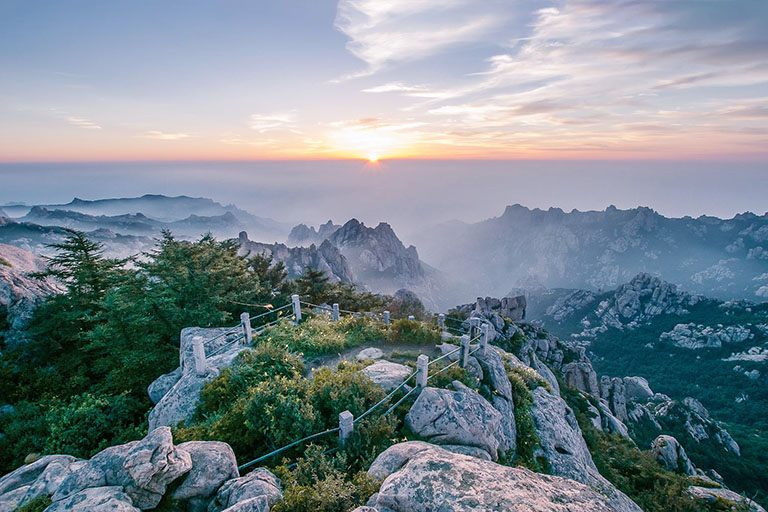
Laoshan Mountain
Taoist peaks dropping into the sea; tea terraces and waterfalls.
Visitor info
- Opening hours
- 07:00-17:30
- Ticket
- 90-130 CNY by route
- Suggested visit
- full day
Price is indicative — final quote on inquiry.
Why it's worth it
The highest mountain on China's coast — 1,133 metres of granite rising straight out of the Yellow Sea, wrapped in Taoist legend, spring water and mist. 'Laoshan water' is a national brand; this is where it comes from.
Don't miss
- The Taiqing Palace complex — Han-dynasty cypresses and Tang temples at the mountain's foot
- The eastern coastal boardwalk line, cliff-hugging between mountain and surf
- Cable car up for the summit sea view on clear days; the ridge trail for the ambitious
Getting there
Bus 104 or 304 from downtown, or a tourist line to the Yangkou/Taiqing entrances — about 90 minutes.
Tips
- Pick one line (Taiqing, Yangkou or Beijiushui) per day; the loop of all three is a myth
- Sea fog rolls in fast — check the summit camera at the ticket office before paying for the cable
- Bottled 'Laoshan spring water' sold on the mountain is the real thing; the cola is an acquired taste
Photos



More in Qingdao
- Zhanqiao Pier
The 1892 pier and Huilan Pavilion, symbol of Qingdao on every beer label.
- Badaguan Scenic Area
Eight named avenues of cherry, ginkgo and German villas.
- Tsingtao Beer Museum
1903 brewery with fresh unfiltered beer and drunch tokens.
- Zhanqiao · Huilan Pavilion
Military pier built in 1892 by General Zhang Gaoyuan of the Qing Dynasty: The pier is 444.5m long extending into Qingdao Bay. Huilan Pavilion (built in 1933 as an octagonal pavilion) is a landmark symbol of Qingdao.
- Little Qingdao
White lighthouse built by Germany in 1899 (commissioned in 1900, still in use for navigation): The island is shaped like a zither, hence the name "Qin Yu" (Zither Isle). "Qin Yu Piao Deng" (Zither Isle Floating Light) is listed among Qingdao's Top Ten Scenic Spots. The rotating tower light at night is a classic image of the old city coastline.
- Signal Hill
A German signal tower built in 1899: marked by three red mushroom buildings, the rotating observation tower offers a 360-degree panoramic view of the red-tiled, green-treed old city—the "red tiles, green trees, blue sea, and blue sky" cityscape is most complete here.