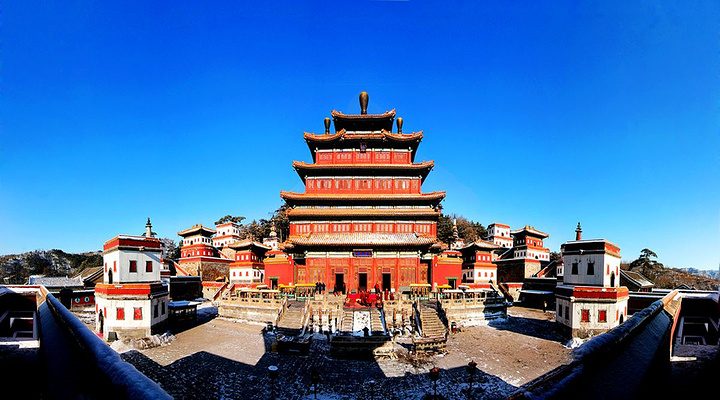
Puning Temple
Built in Qianlong's 20th year (1755) after the pacification of the Dzungars, modeled on Samye Monastery in Tibet; its name means 'peace throughout the realm,' with a mandala layout blending Han and Tibetan styles
Visitor info
- Opening hours
- 08:30-17:30
- Ticket
- CNY 80 in peak season / CNY 60 in off-season
Price is indicative — final quote on inquiry.
Built in Qianlong's 20th year (1755) after the pacification of the Dzungars, modeled on Samye Monastery in Tibet; its name means 'peace throughout the realm,' and its mandala layout blends Han and Tibetan styles. The thousand-armed, thousand-eyed Guanyin (Avalokiteshvara) statue inside the Mahayana Pavilion (Dasheng Pavilion) stands 27.21 m tall, one of the tallest extant wooden Buddha statues in the world. Lamas still reside and practice here, making it the one among the Eight Outer Temples whose religious life continues to this day; annual temple fairs and blessing activities flourish. Its highlights lie on three levels: architecture, statuary, and living faith.
Getting there: Bus, Puning Temple stop
Photos
More in Chengde
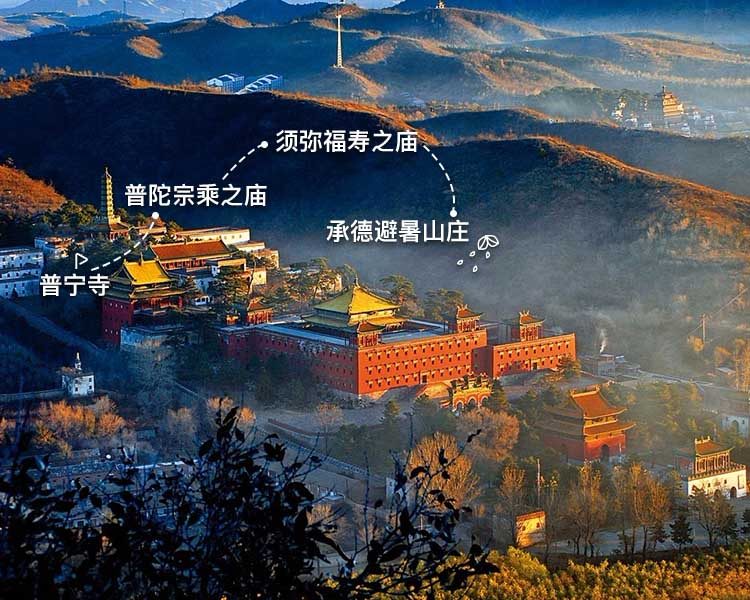
- Chengde Mountain Resort
A UNESCO World Heritage Site (inscribed 1994) and national 5A-level scenic area; the largest surviving imperial garden in China (approx. 5.64 million sq m), laid out in four zones — palace, lake, plain, and mountain — dotted with the 72 Kangxi-Qianlong scenic spots
- Putuo Zongcheng Temple (Little Potala Palace)
The largest of the Eight Outer Temples, built between Qianlong's 32nd year (1767) and his 36th year in imitation of the Potala Palace in Tibet, to celebrate the Empress Dowager's 80th birthday and receive congratulations from princes of the various ethnic groups
- Xumi Fushou Temple
A residence built in Qianlong's 45th year (1780) for the 6th Panchen Lama, who came to the Mountain Resort to congratulate Qianlong on his 70th birthday; modeled on Tashilhunpo Monastery in Shigatse, its name invokes the fortune, longevity and auspiciousness of Mount Sumeru
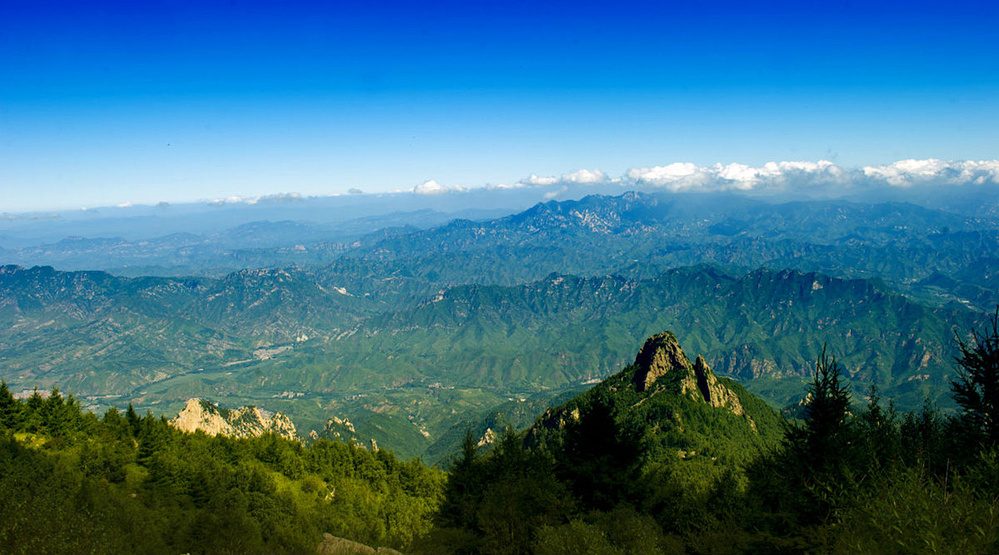
- Qingchui Peak National Forest Park
Famed for the solitary stone pillar Qingchui Peak (popularly known as Bangchui Mountain, 'Sledgehammer Mountain'), which stands over 38 m tall, thick on top and tapering below—a landmark of the Danxia landform left by eons of weathering and collapse; Qing emperors once composed poems praising it
- Chengde Museum
Opened in 2019, with the permanent exhibition 'Looking Both Inside and Outside the Great Wall: A True Record of Ethnic Unity in the Qing Heyday,' systematically displaying artifacts from the Mountain Resort and the Eight Outer Temples and the history of Qing-dynasty ethnic interaction
- Jinshanling Great Wall (Luanping)
A premier section of the Ming Great Wall, a nationally protected key heritage site and part of the Great Wall UNESCO World Heritage Site; supervised and rebuilt by Qi Jiguang and Tan Lun from the Longqing through Wanli reigns (from 1567)