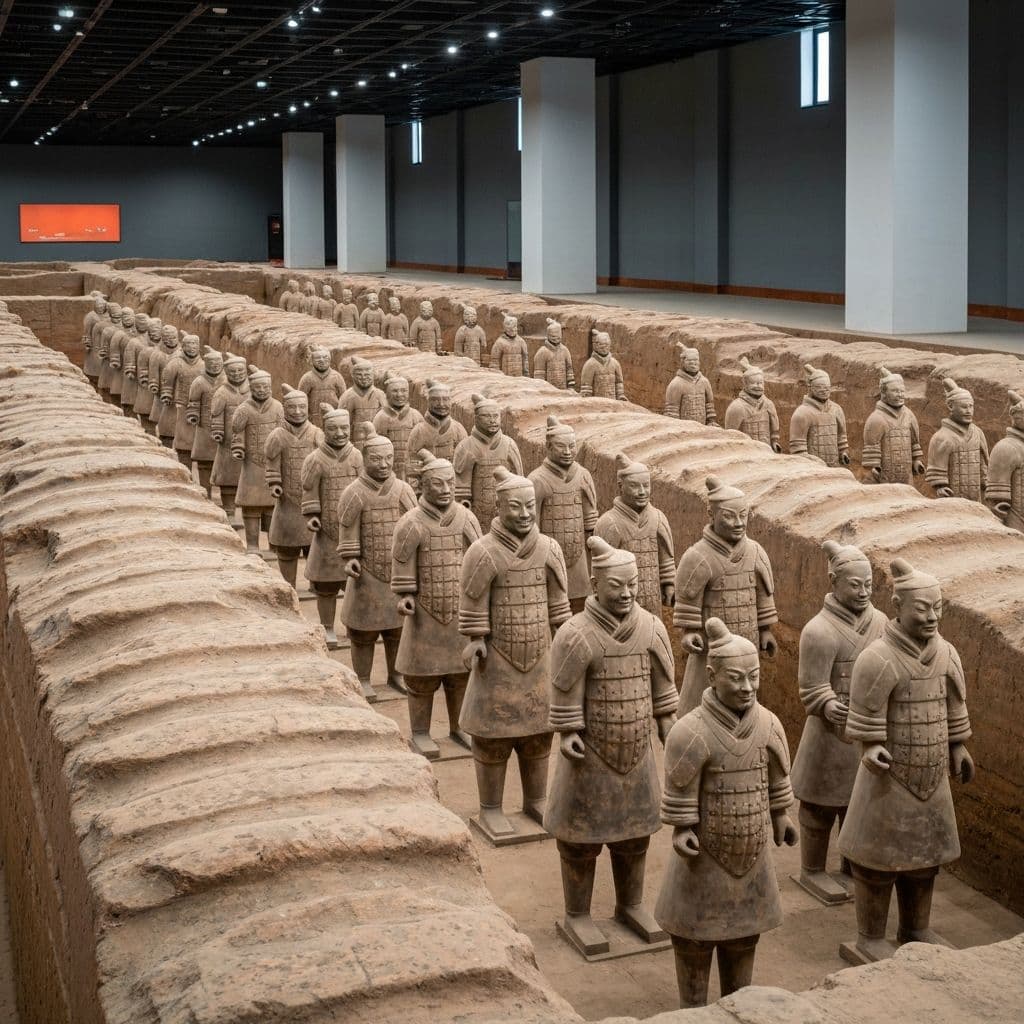
Terracotta Army
8,000 life-size clay warriors guarding Emperor Qin Shi Huang since 210 BC.
Visitor info
- Opening hours
- 08:30-17:00
- Ticket
- 120 CNY (Mar-Nov)
- Suggested visit
- half day
Price is indicative — final quote on inquiry.
Why it's worth it
The army that guarded China's first emperor for 2,200 years — found in 1974 by farmers digging a well. Around 8,000 life-size warriors and horses stand in three pits, no two faces alike, originally painted in bright lacquer that flaked on contact with air.
Don't miss
- Pit 1 — the 6,000-strong infantry formation; stand on the gallery and just look before you photograph
- The two bronze chariots in the museum hall — half-size but fully detailed, cast in 3,000 parts
- The 'well' marker where the farmers actually struck clay in 1974
Getting there
40 km east of the city. Tourist Bus 5 (306) from Xi'an Railway Station square, roughly hourly, about 70 minutes; a DiDi costs more but drops you at the gate.
Tips
- The official guide service at the entrance is genuinely worth it — the site is confusing and the stories are the point
- Start with Pit 3, then Pit 2, and save Pit 1 for last so the big formation lands as the finale
- Skip lunch at the site; combine with the Huaqing Palace pools on the way back if you must fill the day
Photos
More in Xi'an
- Big Wild Goose Pagoda
Tang-dynasty Buddhist pagoda with nightly musical fountain.
- Muslim Quarter
Lantern-lit food alleys behind the Drum Tower since the Tang dynasty.
- Xi'an City Wall
Ride a bicycle on the best-preserved Ming city wall in China.
- Emperor Qinshihuang's Mausoleum Site Museum
Discovered by villager Yang Zhifa while digging a well in 1974, the "Eighth Wonder of the World": Over 6,000 terracotta warriors in the First Pit infantry formation with "a thousand faces, a thousand looks"; the Second Pit features mixed arms formations and kneeling archers and green-faced figures; the Third Pit is the command headquarters; the Bronze Chariot and Horse Museum's First Chariot and Second Chariot are known as the "Crown of Bronze..."
- Emperor Qinshihuang's Mausoleum (Lishan Garden)
The resting place of China's first emperor (built for 38 years, mobilizing 720,000 laborers): The burial mound has not been excavated—legends state it was "filled with mercury to simulate rivers, lakes, and seas" to mimic the terrain, which awaits archaeological verification; pit burials such as the Acrobatics Pit, Civil Official Pit, and Stone Armor Pit display the skills of various trades in the Qin Dynasty.
- Huaqing Palace (Huaqing Pool · Lishan)
The site of King You of Zhou's Liguang Palace and the hot spring palace expanded by Emperor Xuanzong of Tang: The ruins of the Haitang Bath (where Yang Guifei was granted a bath) and the other five sets of imperial bath ruins, such as the Xingchen Bath and the Lotus Bath, are the actual setting for the poetic scene of "Spring Cold, Bathing in Huaqing Pool."