Tiger Hill
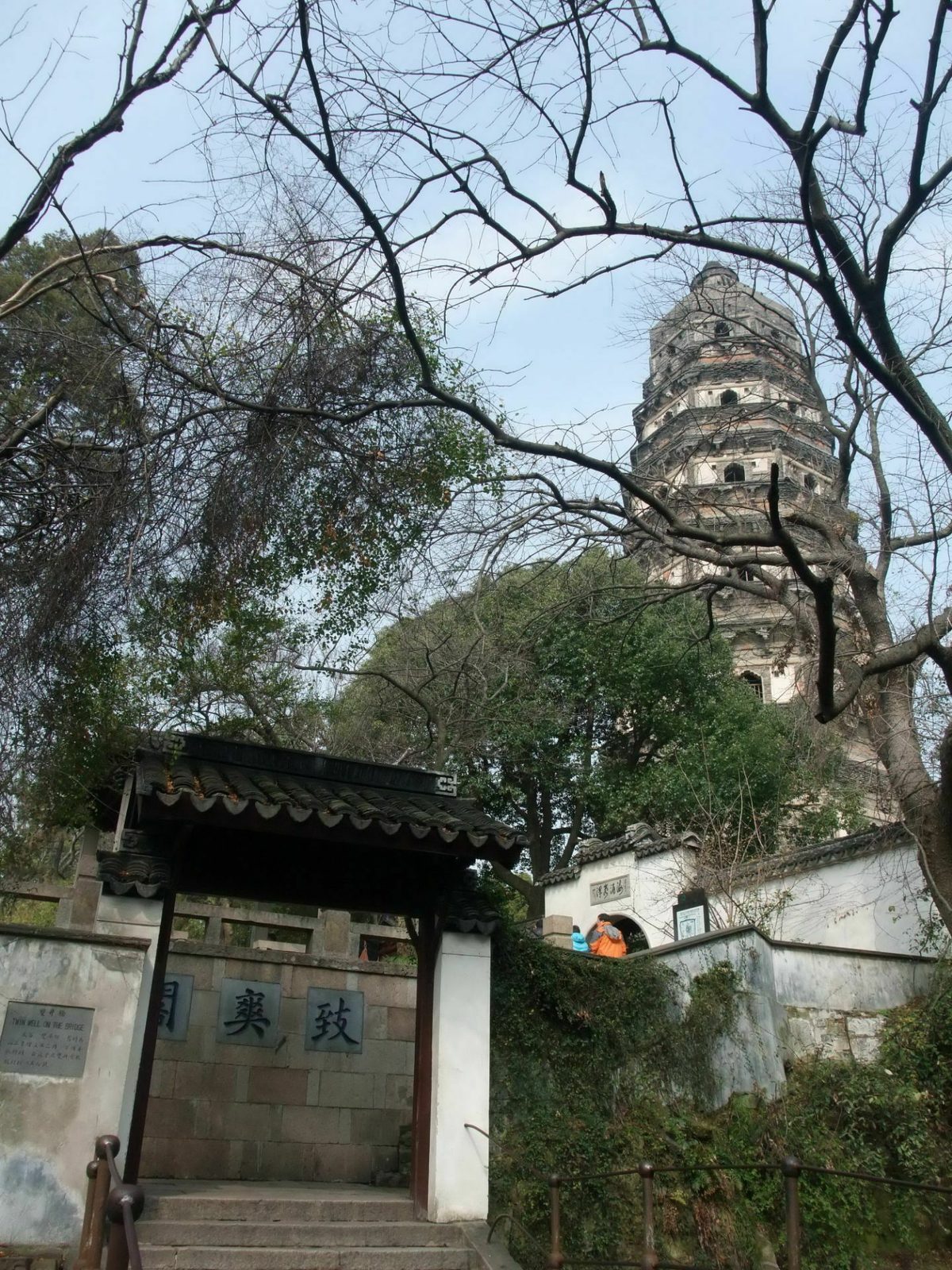
“The number one scenic spot of Wu” (Su Dongpo: “to visit Suzhou and not tour Tiger Hill would be a regret”); Tiger Hill Pagoda (Yunyan Pagoda, built 959, a seven-story leaning tower 47.5 m tall, “the Leaning Tower of Pisa of the East,” one of China's oldest surviving brick pagodas)
Visitor info
- Opening hours
- 07:30-17:30
- Ticket
- Peak season CNY 70
Price is indicative — final quote on inquiry.
Su Dongpo's line “to visit Suzhou and not tour Tiger Hill would be a regret” has served as the hill's thousand-year advertisement; the hill is low but full of presence, long styled “the number one scenic spot of Wu.” Tiger Hill Pagoda was built in 959 (6th year of Xiande, Later Zhou of the Five Dynasties); the seven-story brick pagoda stands 47.5 m tall and leans more than two degrees to the northeast — “the Leaning Tower of Pisa of the East” and one of the oldest surviving brick pagodas in China. The Sword Pool (Jianchi) lies deep and dark: legend has it King Helü of Wu was buried at its bottom with three thousand swords as funerary treasure, and the four characters “Huqiu Jianchi” (Tiger Hill Sword Pool) are said to be in the hand of Yan Zhenqing. The Thousand People Rock (Qianren Shi) is flat as a whetstone; the tale that the Jin-dynasty monk Master Sheng preached here until “even the stones nodded” lends the hill a Zen air. Every Mid-Autumn Festival a kunqu singing gathering is held on the Thousand People Rock, while the Tiger Hill temple fair and the autumn candied-hawthorn fair (Tangqiu Hui) keep alive old Suzhou's folk memories.
Getting there: On foot from Shantang Street / Bus 146
Photos
More in Suzhou
- Humble Administrator's Garden
Built in the fourth year of the Ming Zhengde reign (1509) by Wang Xianchen, with Wen Zhengming participating in the design, the 'Mother of Chinese Gardens' (a representative Jiangnan garden): Hall of Distant Fragrance / Little Flying Rainbow (Suzhou's only covered bridge) / 'With Whom Shall I Sit' Pavilion
- Suzhou Museum (Main Building)
I.M. Pei's final masterpiece (opened 2006), 'Chinese yet new, Suzhou yet new'; the sliced-rock hillside borrows the white wall of the Humble Administrator's Garden as its backdrop
- Lion Grove Garden
Built in 1342 (2nd year of the Yuan Zhizheng era) by Zen Master Tianru (Lion Grove Chan Temple); a labyrinth of Taihu Lake rockeries ('kingdom of rockeries', nine interweaving routes); Emperor Qianlong visited six times and inscribed 'True Delight'
- Lingering Garden
Xu Taishi built the East Garden in the Ming Wanli era; Liu Shu's Hanbi (Cold Green) Villa in the Qing dynasty
- Master of the Nets Garden
Site of Southern Song Shi Zhengzhi's Wanjuan Hall ('Fisherman's Retreat'); rebuilt in the Qianlong era of the Qing by Song Zongyuan as the 'Master of the Nets' (fisherman, his self-styled name)
- Canglang Pavilion
Built in 1045 (5th year of the Northern Song Qingli era) by Su Shunqin, Suzhou's oldest surviving garden ('scenery before you enter the gate' — double corridor with lattice windows); the famous couplet 'A clear breeze and bright moon are priceless' (assembled from lines by Ouyang Xiu and Su Shunqin)