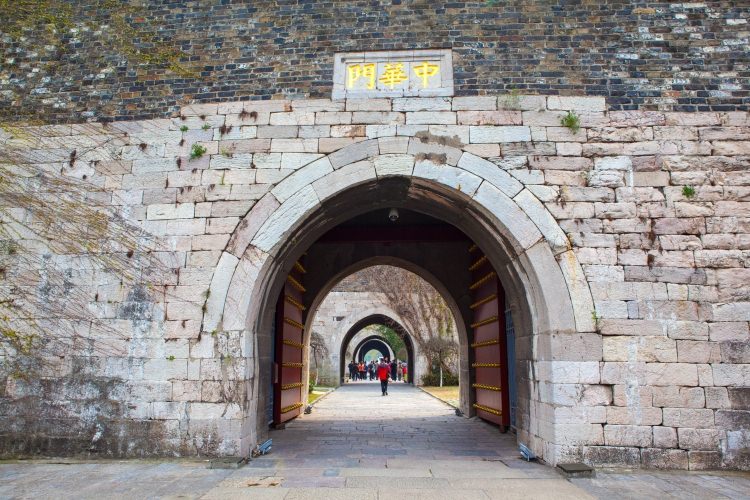
Zhonghua Gate
The world's largest castle-style city gate, 27 soldier hideouts inside.
Visitor info
- Opening hours
- 08:00-20:00
- Ticket
- 50 CNY
- Suggested visit
- 1-2 hours
Price is indicative — final quote on inquiry.
Why it's worth it
The biggest castle-style city gate in China, finished 1386 — 20,000 workers, bricks stamped with the names of their makers (a quality-control death clause), and 13 soldier-hiding vaults inside the rampart's belly.
Don't miss
- The brick inscriptions — find a maker's name and a prefecture stamped 600 years ago
- The arched cunbing caves (soldier stores), empty now and enormous
- Walking the wall-top towards the old quarter with the Qinhuai below
Getting there
Metro Line 1 to Zhonghuamen, Exit 2; the gate complex is directly north of the station.
Tips
- An hour does it; pair with a wall-walk extension if the weather holds
- The legend of the buried treasure bowl (Shen Wanshan's 'treasure basin') is on the boards inside — read it there
- Afternoons are quiet; the gate faces west so evening light hits the brickwork
Photos


More in Nanjing
- Sun Yat-sen Mausoleum
392 marble steps up Purple Mountain to the father of modern China.
- Ming Xiaoling Mausoleum
Sacred Way stone animals guarding the tomb of the Ming founder.
- Confucius Temple (Fuzimiao)
Qinhuai River lantern district; night cruise past painted boats.
- Sun Yat-sen Mausoleum
The mausoleum of Dr. Sun Yat-sen, begun in 1926 with his remains interred in 1929. The "Liberty Bell" ground plan by young architect Lü Yanzhi won a global design competition, a milestone of modern Chinese architectural history.
- Ming Xiaoling Mausoleum
The joint tomb of Ming founder Zhu Yuanzhang and Empress Ma, begun in 1381. It pioneered the "court in front, resting quarters behind" mausoleum layout, the wellspring of the Ming-Qing imperial tomb system; in 2003 it was inscribed as a UNESCO World Heritage Site as part of the extension of the Imperial Tombs of the Ming and Qing Dynasties.
- Linggu Temple
An ancient temple at the southern foot of Purple Mountain, descended from the Liang-dynasty Kaishan Temple; relocated and renamed Linggu Temple in the early Ming, its old view "Deep Pines of Linggu" was listed among the Forty-Eight Scenes of Jinling.