Nanjing Yangtze River Bridge
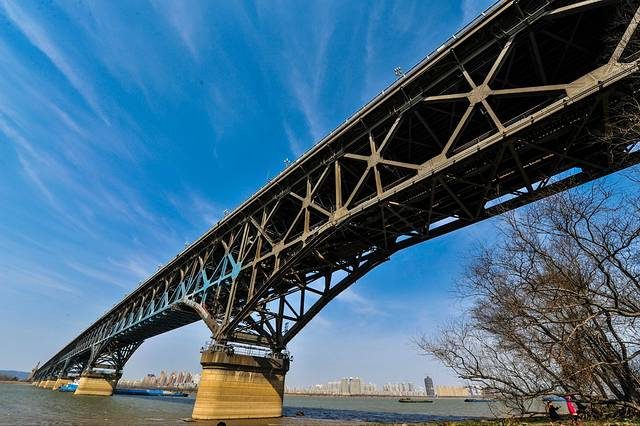
Completed in 1968 as China's first self-designed and self-built double-decker rail-and-road bridge (the road-rail "Bridge of Pride"); magnolia-shaped street lamps and bridgeheads with three red flags
Visitor info
- Opening hours
- All day
- Ticket
- Bridgehead free
Price is indicative — final quote on inquiry.
Completed in 1968 as China's first self-designed and self-built double-decker rail-and-road bridge (the road-rail "Bridge of Pride"); magnolia-shaped street lamps and bridgeheads bearing three red flags; glass walkway views at Nanbao Park. Built in an era of scarcity entirely by Chinese designers and builders, the bridge shattered the claim that "the Chinese could not build large bridges on their own"; the three red flags and worker-peasant-soldier sculptures on the bridgeheads became the collective memory of a generation. The glass walkway in Nanbao Park stretches out over the river: trains thunder through the steel girders beneath your feet while 10,000-ton freighters pass under the bridge arches — this "double-deck crossing" spectacle is the best spot for viewing the bridge, and the bridge history exhibition hall tells the stories of its builders.
Getting there: Bus / by taxi (Nanbao Park)
Photos
More in Nanjing
- Sun Yat-sen Mausoleum
392 marble steps up Purple Mountain to the father of modern China.
- Ming Xiaoling Mausoleum
Sacred Way stone animals guarding the tomb of the Ming founder.
- Confucius Temple (Fuzimiao)
Qinhuai River lantern district; night cruise past painted boats.
- Zhonghua Gate
The world's largest castle-style city gate, 27 soldier hideouts inside.
- Sun Yat-sen Mausoleum
The mausoleum of Dr. Sun Yat-sen, begun in 1926 with his remains interred in 1929. The "Liberty Bell" ground plan by young architect Lü Yanzhi won a global design competition, a milestone of modern Chinese architectural history.
- Ming Xiaoling Mausoleum
The joint tomb of Ming founder Zhu Yuanzhang and Empress Ma, begun in 1381. It pioneered the "court in front, resting quarters behind" mausoleum layout, the wellspring of the Ming-Qing imperial tomb system; in 2003 it was inscribed as a UNESCO World Heritage Site as part of the extension of the Imperial Tombs of the Ming and Qing Dynasties.